Why it matters
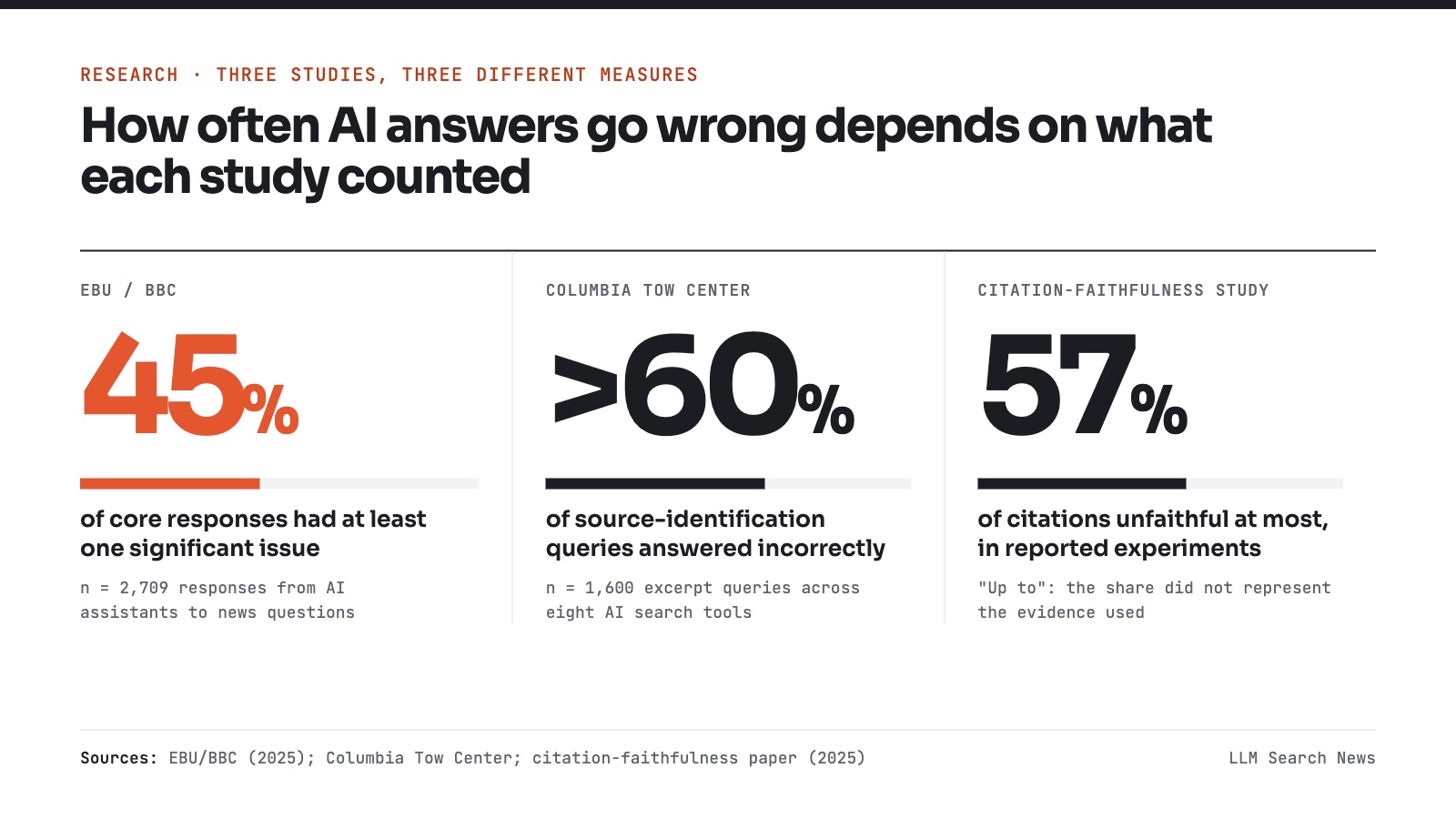
- The 2025 EBU/BBC study found significant issues in 45% of 2,709 evaluated news responses, while 81% contained some minor or significant issue.[7]
- The Tow Center found that more than 60% of 1,600 controlled source-identification queries produced incorrect results, with Grok 3 incorrect on 94% of its test queries.[1][3]
- Academic studies distinguish factual accuracy, citation faithfulness, URL validity and source selection rather than treating them as one error category.[4]
- A live citation can resolve without supporting the claim, so URL validity is not proof of citation correctness.[4]
- The available evidence does not establish one universal 2026 AI-search error rate, and the 2025 EBU/BBC and Tow Center figures should not be presented as current platform ratings.[3]
As of 17 November 2026, no single study establishes a universal error rate for AI search. The strongest available evidence instead measures different problems: the EBU/BBC found significant issues in 45% of evaluated news responses in 2025, while a separate Tow Center test produced incorrect results for more than 60% of controlled source-identification queries.[1]
What happened in the latest AI search accuracy studies?
Recent studies have examined four related but distinct questions:
- Does the answer accurately represent the news or evidence? The EBU/BBC study evaluated news responses for accuracy, context and sourcing problems.[2]
- Can the system identify the correct source? The Tow Center tested whether tools could recover an article and its metadata from an excerpt.[3]
- Does a citation resolve and support the claim? Academic studies separately measured URL validity, citation faithfulness and source selection.[4]
- Can an assistant answer questions about newly published facts? LiveBrowseComp tested information published within the previous 90 days.[5]
These studies use different units—responses, queries, definitive answers or URLs—so their percentages cannot be combined into one AI-search accuracy score.[1]
| Study | Engines or systems | Sample | Key finding | Date |
|---|---|---|---|---|
| EBU/BBC News Integrity in AI Assistants | AI assistants used for news questions | 2,709 core responses, plus 353 custom responses | 45% of core responses had at least one significant issue; 81% had some issue when minor and significant issues were combined.[2][6] | Responses generated 24 May–10 June 2025; report published October 2025.[7] |
| Columbia Tow Center source-identification test | ChatGPT Search, Perplexity, Perplexity Pro, DeepSeek Search, Copilot, Grok 2, Grok 3 beta and Gemini | 1,600 excerpt-based queries | More than 60% of results were incorrect overall; Perplexity was incorrect on 37% and Grok 3 on 94% of queries.[3] | 2025.[3][8] |
| Citation-faithfulness study | LLM-based information-retrieval systems | Reported experiments on citation attribution | Up to 57% of citations lacked faithfulness, meaning the citation did not reliably represent the evidence used to produce the answer.[1][4] | 2025. |
| Chinese factual-search benchmark | Nine search engines, standalone LLMs and AI Overviews | Evidence-derived Chinese yes/no questions | Conditional accuracy ranged from 73.2% to 78.9%, while end-to-end accuracy was lower for several systems when uncertainty counted as an error.[1] | 2026.[1] |
| Reference-hallucination study | Ten commercial LLMs and deep-research agents | DRBench citation outputs | 3.0%–13.3% of citation URLs were hallucinated and 5.4%–18.5% were non-resolving.[4] | 2026. |
| Google AI Overviews citation audit | Google AI Overviews | Citation-selection analysis | AI-generated documents were cited more frequently than human-authored documents after retrieval rank was controlled, largely because of non-retrieved citations.[9] | 2026.[9][4] |
| LiveBrowseComp | Search-augmented agents | 335 questions about facts published within the previous 90 days | All evaluated agents scored below 2% closed-book accuracy; search-augmented scores were 25–40 points below BrowseComp.[5] | 2026. |
Why does this matter?
AI search answers can fail in more than one way. A response may state a false fact, omit necessary context, identify the wrong publisher, provide a broken URL, cite a live page that does not support the claim, or rely on a source without faithfully reflecting it.[4]
The distinction is especially important for news. In the EBU/BBC study, sourcing was the most common significant problem category, affecting 31% of core responses. Accuracy issues affected 20%, while insufficient-context issues affected 14%.[6]
The study’s 81% figure also requires careful wording. It means that 81% of evaluated responses contained at least one issue when minor and significant issues were included; it does not mean that 81% of answers were seriously false.[7]
Citation presence is not equivalent to citation correctness. A URL can resolve successfully while failing to support the statement attached to it, while a citation-faithfulness test asks whether the source genuinely supports the generated claim rather than merely being attached after the answer was formed.[4]
Freshness creates another difficulty. LiveBrowseComp used questions about facts published during the 90 days before benchmark construction, and the evaluated agents performed poorly on that time-sensitive task.[5] A system can therefore appear reliable on established facts while struggling with newly reported events.
What do we know about the EBU/BBC findings?
The EBU/BBC report brought together 22 public-service media organizations across 18 countries and 14 languages. In total, 271 journalists reviewed 2,709 core-question responses and 353 custom-question responses.[3]
The core responses were generated between 24 May and 10 June 2025.[7] Reviewers assessed news answers for categories including accuracy, sourcing and context.
The principal results were:
- 45% of core responses contained at least one significant issue.[2]
- 81% contained an issue when minor and significant issues were counted together.[7][2]
- Significant sourcing issues affected 31% of responses.[2]
- Accuracy issues affected 20% of responses.[6][2]
- Context issues affected 14% of responses.[7][2]
The report also describes a BBC-to-BBC comparison in which the share of responses with significant issues fell from 51% in an earlier round to 37%.[6] The report cautions that the broader multi-publisher results cannot be directly compared with the first BBC-only study.[6]
The evaluation was not adversarial and was not designed to compare countries or languages.[4] A like-for-like 2026 EBU/BBC result with a new comparable percentage is not verified in the primary material available for this article.
What did the Tow Center test actually measure?
The Tow Center tested eight generative search tools: ChatGPT Search, Perplexity, Perplexity Pro, DeepSeek Search, Microsoft Copilot, Grok 2, Grok 3 beta and Google Gemini.[3]
Researchers selected ten articles from each of 20 publishers, supplied excerpts and asked the systems to identify the headline, original publisher, publication date and URL.[3] This produced 1,600 queries.[1]
The scoring required the system to identify the correct article, publisher and URL. More than 60% of answers were incorrect overall.[3] Perplexity was incorrect on 37% of its queries, while Grok 3 was incorrect on 94%.[3]
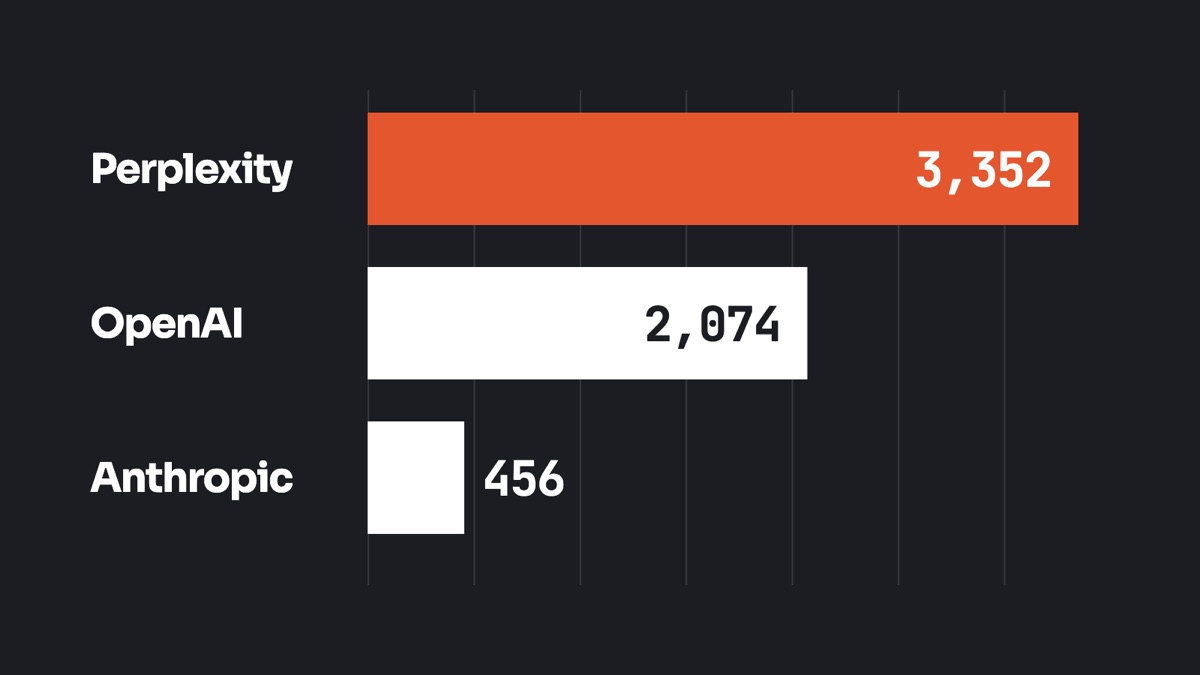
DeepSeek misattributed the source of excerpts 115 times out of 200.[3] More than half of Gemini’s and Grok 3’s responses cited fabricated or broken URLs, and 154 of Grok 3’s 200 citations led to error pages.[3]
The test does not provide a general accuracy rate for open-ended AI search. It measured a controlled source-identification task in which systems had to recover a known article and associated metadata from an excerpt.[3] The researchers also cautioned that the task might not reflect typical user behavior, that each excerpt was queried once and that the findings should not be extrapolated to all models or news organizations.[3]
A comparable 2026 Tow Center re-test is not verified in the primary Tow Center material used here.[3][8]
What do academic studies add?
Citation faithfulness is different from citation correctness
A 2025 study distinguishes citation correctness from citation faithfulness. Correctness asks whether a cited document supports a statement; faithfulness asks whether the system genuinely relied on that document rather than producing an answer first and attaching a plausible source afterward.[4]
The study reported that up to 57% of citations lacked faithfulness.[10] That result concerns citation attribution in LLM-based information retrieval and is not a live audit of every consumer AI search product.[1]
URL validity is not evidence support
A 2026 study of ten commercial LLMs and deep-research agents tested citation outputs on DRBench.[4] It found that 3.0%–13.3% of citation URLs were hallucinated and 5.4%–18.5% were non-resolving.[4]
The study defined a non-resolving link as a URL that returned an HTTP error or failed to connect. A hallucinated URL was a non-resolving URL with no archived Wayback Machine snapshot.[4]
Those measurements concern whether URLs exist and resolve. They do not directly measure whether a working page supports the claim made in the answer.[4]
Source selection can also be biased
A 2026 audit of Google AI Overviews found that AI-generated documents were cited more often than human-authored documents even after retrieval rank was controlled.[9] The difference was driven mainly by citations to documents that were not retrieved in the underlying search process.[9]
This is a source-selection and provenance finding, not a claim that every affected citation was false or an overall percentage of incorrect citations.[4]
Fresh factual information remains difficult
LiveBrowseComp contains 335 human-authored questions about facts published in the 90 days before the benchmark was constructed.[5] All evaluated agents scored below 2% on the closed-book version, and search-augmented results were 25–40 points lower than BrowseComp scores.[5]
The benchmark measures performance on recent information. It does not establish citation correctness across search products.[1]
What is confirmed, and what is not?
Confirmed by the cited studies
- The EBU/BBC’s 2025 news study found significant issues in 45% of 2,709 core responses.[6]
- The same study found some issue, minor or significant, in 81% of core responses.[1]
- Significant sourcing issues were the largest reported category, affecting 31% of core responses.[2]
- The Tow Center’s 1,600-query source test produced incorrect results in more than 60% of cases overall.[4][3]
- Citation studies measure separate failure modes, including URL resolution, citation faithfulness and source selection.[4]
- Fresh-fact benchmarks show that current information can be substantially harder for agents than established information.[7]
Not confirmed by this evidence
- There is no single overall 2026 error rate for all AI search answers.[3][4]
- The EBU/BBC 2025 percentage is not a current November 2026 platform rating.[7]
- The Tow Center’s result is not a general factual-accuracy percentage for every search query.[1][7]
- A resolving URL does not prove that the cited page supports the answer.[4]
- A citation-selection difference does not prove that every selected citation is incorrect.[3]
- The available material does not verify a like-for-like 2026 EBU/BBC or Tow Center re-test.[3]
How should AI search accuracy be reported?
A technically meaningful report should identify the task, sample, denominator, date and failure definition.
- Name the task. State whether the study measured news quality, source identification, factual correctness, citation support, URL validity or freshness.
- Name the denominator. Specify whether the percentage refers to responses, queries, claims, definitive answers or URLs.
- Give the collection date. AI-search outputs change over time, and the EBU/BBC responses, for example, were generated during a defined 2025 period.[1][7]
- Separate conditional and end-to-end accuracy. A system can be accurate when it answers definitively but perform worse when uncertain or missing answers count as failures.[1]
- Do not treat citations as binary proof. Check whether the URL resolves, whether the page supports the claim and whether the response faithfully reflects the source.[4]
- Avoid a blended headline percentage. The current evidence does not support one universal 2026 AI-search error rate.[1][4]
Background: why AI search accuracy studies disagree
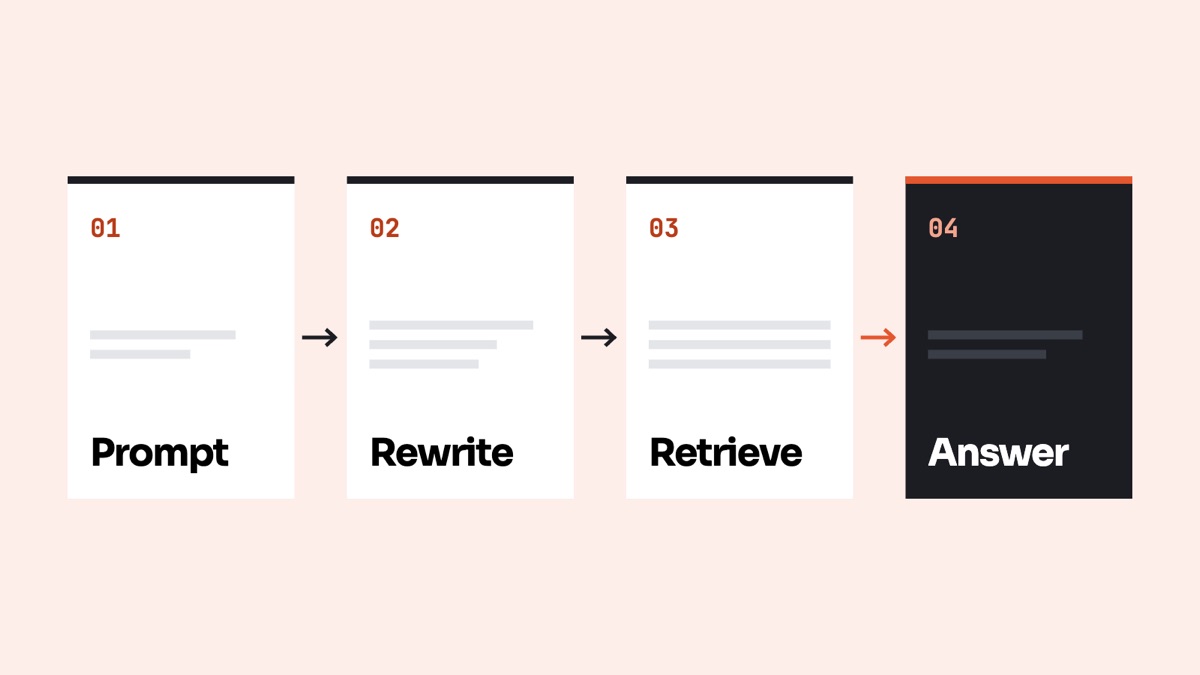
AI-search systems generate answers through different combinations of retrieval, ranking, model generation and citation selection. A benchmark that asks a system to identify a known article therefore tests a different capability from one that asks whether a newly published fact is correct.
The denominator also changes the result. A study counting invalid URLs can report a URL-level failure rate even when the surrounding answer is correct. A study counting response-level significant issues can include sourcing, context and accuracy problems in the same response. A benchmark that counts uncertain answers as wrong will produce a lower end-to-end score than one that evaluates only definitive answers.[1]
For that reason, percentages should always remain attached to the study design that produced them.
Frequently asked questions
How accurate are AI search engines in 2026?
There is no verified universal 2026 accuracy rate for AI search engines. Available studies report different results because they test different tasks, including news quality, source identification, citation validity and fresh-fact retrieval.[4]
What percentage of AI news answers were wrong in the EBU/BBC study?
The 2025 EBU/BBC study found that 45% of 2,709 core responses had at least one significant issue. When minor and significant issues were combined, 81% had some issue; the study did not say that 81% of answers were seriously false.[7]
What did the Tow Center find about ChatGPT citations?
The Tow Center tested ChatGPT Search alongside seven other generative search tools in a controlled source-identification task. More than 60% of all results were incorrect, but the published overall figure covers article, publisher and URL identification across the full test rather than ChatGPT’s general factual accuracy.[4][3]
Does a working AI citation prove that an answer is correct?
No. A working URL only shows that the address resolves; it does not establish that the page supports the claim. Citation-faithfulness research separately examines whether the answer genuinely reflects the cited evidence.[1][4]
Why do some AI accuracy studies report higher numbers?
Studies may count only definitive answers, while others count uncertain or missing answers as errors. In the Chinese factual-search benchmark, conditional accuracy was higher than end-to-end accuracy because the end-to-end measure penalized uncertainty and incomplete answer coverage.[1]
Sources
- 1Evaluating Reliability Asymmetries in Chinese Factual Search and AI Answers arxiv.org
- 2Largest study of its kind shows AI assistants misrepresent news content 45% of the time – regardless of language or territory bbc.com
- 3AI Search Has a Citation Problem - Columbia Journalism Review cjr.org
- 4Detecting and Correcting Reference Hallucinations in Commercial LLMs and Deep Research Agents arxiv.org
- 5[2605.28721] LiveBrowseComp: Are Search Agents Searching, or Just Verifying What They Already Know? arxiv.org
- 6News Integrity in AI Assistants bbc.co.uk
- 7Search Engines in the AI Era: A Qualitative Understanding to the False Promise of Factual and Verifiable Source-Cited Responses in LLM-based Search | Proceedings of the 2025 ACM Conference on Fairness, Accountability, and Transparency dl.acm.org
- 8Tow Center's Latest Report on AI Search Engines | Columbia Journalism School journalism.columbia.edu
- 9Auditing Citation Behavior in AI-Generated Search Summaries: A Framework and a Case Study of Google AI Overviews proceedings.mlr.press
- 10Correctness is not Faithfulness in Retrieval Augmented Generation Attributions | Proceedings of the 2025 International ACM SIGIR Conference on Innovative Concepts and Theories in Information Retrieval (ICTIR) dl.acm.org